

When my husband Brent and I went on an Alaskan cruise, one of our excursions took us out to Betton Island via a motorized ocean raft. This island is a part of the Tongass National Forest—America’s largest national forest, in case you were wondering.

Once we had left the choppy waters of the Clover Passage and shed our life jackets and bulky rain slickers, we found ourselves on an island where we felt like we’d been dropped in the middle of a fairy tale. Dappled sunlight filtered through the leafy canopy above our heads as it streamed down onto unfurled ferns and mossy logs below. It was enchanting.
The Tongass is an old growth temperate rainforest which means it’s incredibly lush with varying shades of green. We walked atop a wooden boardwalk zigzagging through the forest so we wouldn’t disturb the flora or fauna blanketing every inch of precious space. (One type of “fauna” we saw was a banana slug, a gooey looking critter that could render a person numb if he touched it. Our guide told us that dentists used to instruct their patients to chew the gelatinous slug before a procedure to ease their tooth pain.)

Our group was led by two guides, one in front and one behind us. Since we were at the back of the group, Brent and I got extra commentary from the guide bringing up the rear. She gave us all kinds of information and answered our questions as we marveled at the views around us.

One of the tidbits we learned during our leisurely hike was about the very tall and (mostly) very old trees. We were surrounded by Sitka Spruce, Western Hemlock, and Red Cedar. What made these towering trees so interesting is that the soil on the island is incredibly shallow. The ground is rocky and compacted, but the roots have learned to adapt, staying fixed within the top layer of soil. They send their roots out instead of down, so over time, they form a woven mat across the forest floor. These roots stretch and curl and reach out to each other to become stable so they can weather the harsh winters together. They even incorporate the decaying logs that have fallen around them into their network of tree roots. These fallen trees are called nurse logs, and they create their own little nursery for baby seedlings and new growth.
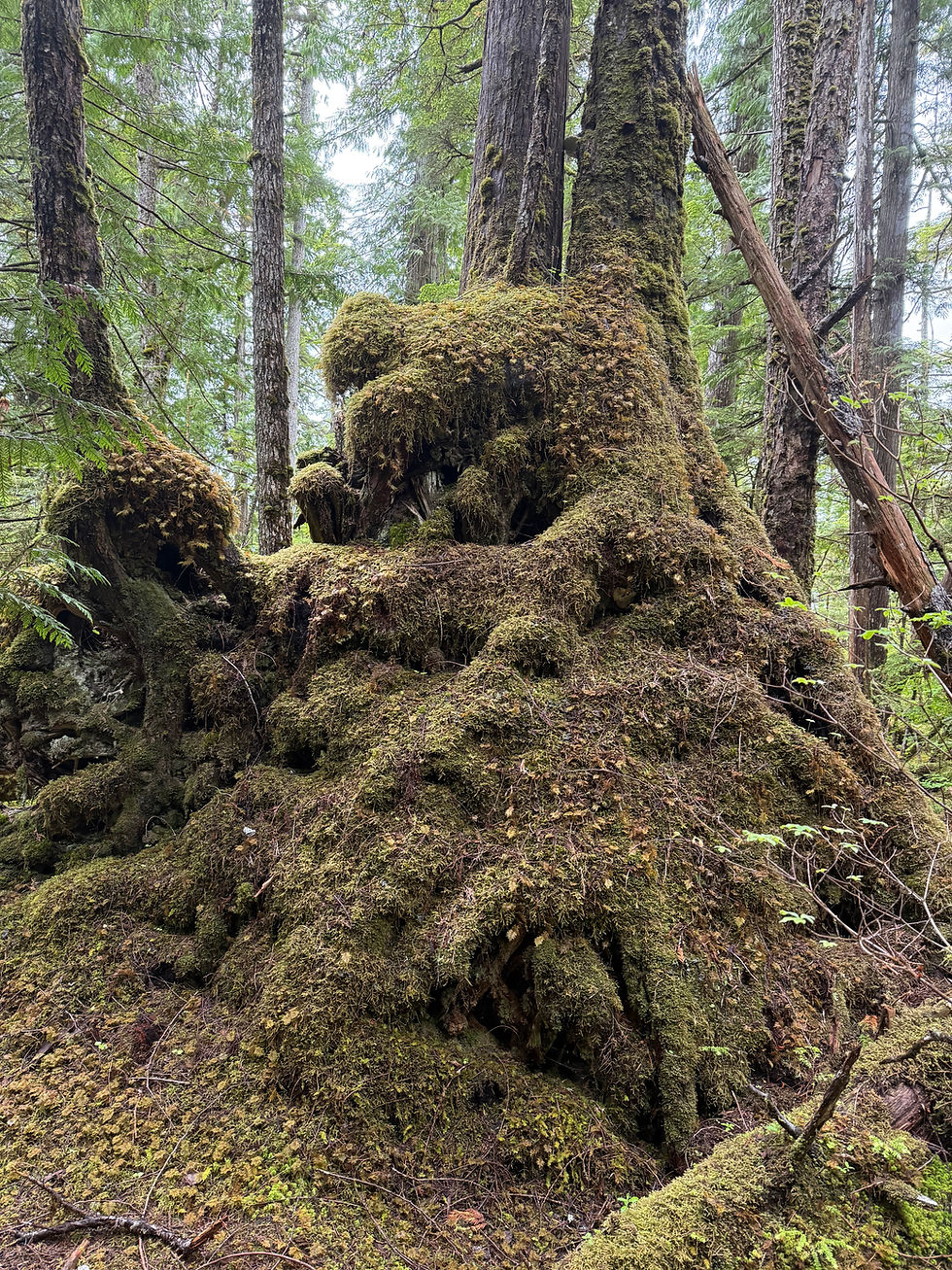
Maybe it’s because the world around me way too often looks like a dumpster fire, reminding me less of God’s beautiful kingdom where mercy and goodness reigns and more of the gloomy predictions from the prophets at the end of the Old Testament, but I really liked the idea of those tree roots grabbing hold of each other. I like the notion that nature gives us an example of what we read in Ecclesiastes 4: “Two are better than one, because they have a good return for their labor: If either of them falls down, one can help the other up. But pity anyone who falls and has no one to help them up. Also, if two lie down together, they will keep warm. But how can one keep warm alone? Though one may be overpowered, two can defend themselves. A cord of three strands is not quickly broken.”
For Heaven’s sake, let’s reach out and help each other up.
Comments